 KATARIBE
Fushimi Inari Taisha 伏見稲荷大社
Head shrine of every Inari shrine in Japan, with a mountain of donated torii behind it.
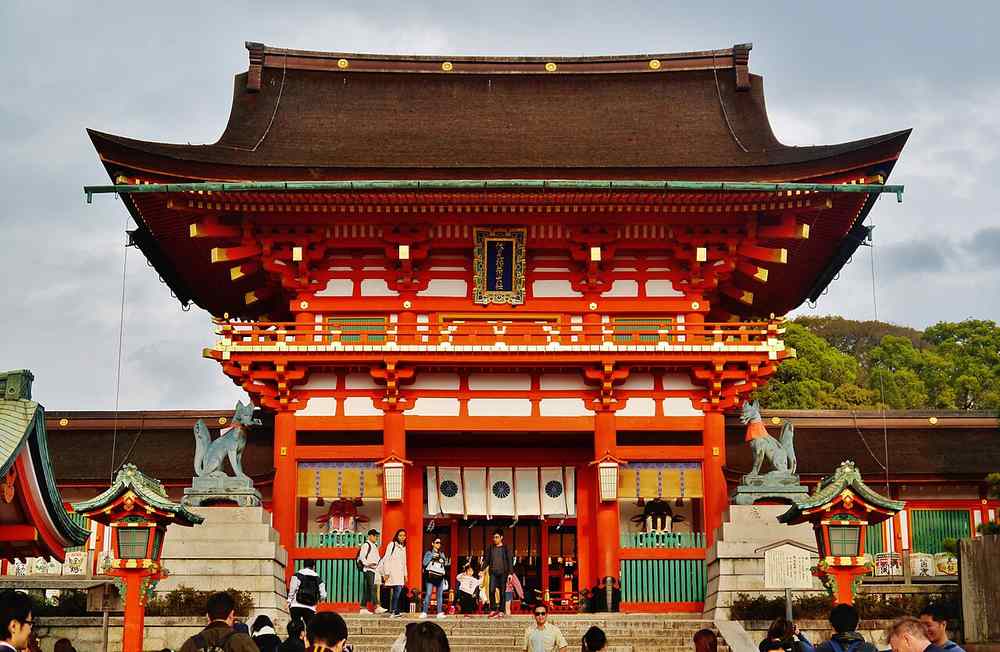 Photo: Wikimedia Commons
Is Fushimi Inari Taisha worth visiting?
Yes, and it costs nothing. Fushimi Inari Taisha is the head shrine of roughly 30,000 Inari shrines across Japan, founded in 711, and the mountain behind it carries around 10,000 torii gates donated by businesses and individuals. The grounds are open around the clock with no entrance fee and no ticket gate. Walking the mountain trails and back takes about two hours; the dense tunnel of gates alone needs far less.
The story
The shrine was founded in 711 by the Hata clan, immigrants from the Korean peninsula who brought irrigation, sericulture and sake brewing to the Kyoto basin. The old provincial record tells it differently. A wealthy landowner named Hata no Irogu shot an arrow at a rice cake for sport; the cake turned into a white bird and flew to the peak, and rice grew where it landed. The name Inari is traced to a phrase meaning rice has grown.
The gates came much later. By the start of the Edo period it had become the custom to donate a torii in hope of a wish or in thanks for one granted, and donors have kept adding them ever since — roughly 10,000 now stand on the mountain, with about 800 packed into the row called Senbon Torii. Higher up, thousands of stone otsuka carry private names for Inari, carved by worshippers who wanted a deity of their own.

Stand under the Senbon Torii and Kunato tells you the rest — including whose names are carved on the backs of the gates, and why every stone altar higher up the mountain says something different.
Hear it in the appVisiting
The official site publishes no opening hours or fees because there are none; the 24-hour, no-fee status is documented on the shrine's English Wikipedia entry and matches the absence of any ticket gate on site.
Questions travellers ask
Before 8:00 a.m. The shrine never closes, so there is no opening queue — the gates simply get busier as trains from Kyoto Station arrive through the morning. Arriving at first light, or coming after dark when the approach and main hall are lit, gives you the Senbon Torii with far fewer people standing in it.
About two hours up and back. The mountain trails cover roughly four kilometres and climb to a summit 233 metres above sea level, passing small shrines, former shrine sites and thousands of stone altars along the way. Many visitors instead stop where the dense gate tunnel ends near the inner shrine, which is a much shorter walk.
Yes. There is no entrance fee and no ticket gate anywhere on the mountain, and the precinct is open twenty-four hours a day. Only optional things cost money: amulets, votive plaques and formal prayers booked at the reception beside the main hall. The precinct covers about 870,000 square metres, all of it freely walkable.

Nearby historic sites in Kyoto
KATARIBE