 KATARIBE
Kinkaku-ji 金閣寺
A gold-leafed pavilion over a mirror pond, rebuilt in 1955 after an arsonist burned it.
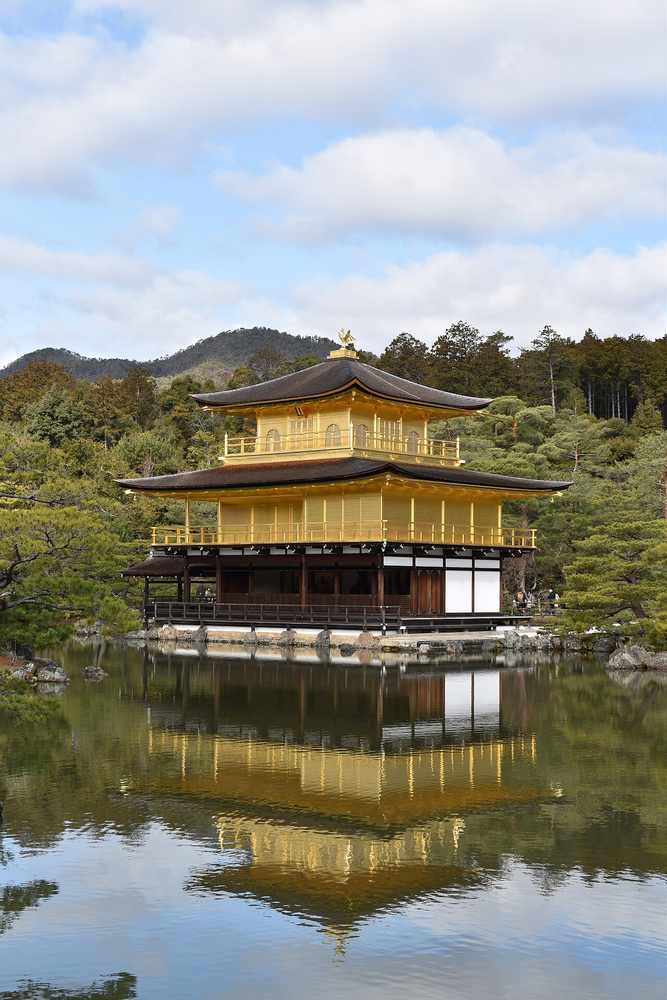 Photo: Wikimedia Commons
Is Kinkaku-ji worth visiting?
Yes, provided you know what you are looking at. The Golden Pavilion in front of you was rebuilt in 1955 after a novice monk burned the original down in 1950, and its gold leaf was replaced in 1987 with a coating far heavier than the first. The garden route is one-way and short: thirty to forty-five minutes covers it, which makes it easy to pair with Ryōan-ji a kilometre away.
The story
The site began as a nobleman's villa. In 1397 the retired shogun Ashikaga Yoshimitsu bought it from the Saionji family and built the pavilion as the centrepiece of his estate — three floors in three different styles, Heian aristocratic below, warrior in the middle, Chinese Zen on top, with gold leaf over the upper two. When Yoshimitsu died his son converted the whole place into a Zen temple, Rokuon-ji, as Yoshimitsu had asked.
At 2:30 in the morning on 2 July 1950, a 22-year-old novice monk named Hayashi Shoken set fire to the pavilion and then walked up the hill behind it to kill himself. He survived; the building did not, and Yoshimitsu's original statue burned with it. Yukio Mishima turned the case into a novel in 1956. The replacement went up in 1955, and in 1987 the lacquer, the gold leaf, the ceiling paintings and the statue were all redone.

Stand at the edge of the Mirror Pond and Kunato tells you the rest — including why the spring behind the pavilion is called Yoshimitsu's teawater, and what the 1950 fire took that no rebuild could return.
Hear it in the appVisiting
The garden is not step-free beyond the pavilion. Wheelchair and stroller users can reach the side of the Golden Pavilion, but must turn back at the stairs past it and exit the way they came in; wheelchairs can be borrowed on the day, subject to availability.
Questions travellers ask
Yes. The temple opens 9:00 to 5:00 every day of the year, winter included, and the visit is a short outdoor circuit rather than an indoor one, so cold is the only real constraint. Snow in Kyoto is occasional rather than dependable, so treat a snow-topped pavilion as luck rather than something you can plan a trip around.
Thirty to forty-five minutes. The route is fixed and one-way: in past the Somon gate, around the Mirror Pond to the viewpoint facing the pavilion, along its side, then up through the garden past Yoshimitsu's spring and the Ryūmon waterfall to the teahouse and the exit. You cannot loop back for a second look.
No. The path takes you right alongside the pavilion but not into it — the building is a shariden, a hall built to hold relics of the Buddha, not a visitor space. The exterior is the point: three storeys in three architectural styles, with the upper two covered in gold leaf laid over lacquer.

Nearby historic sites in Kyoto
KATARIBE