 KATARIBE
Meiji Jingū 明治神宮
A 1920 shrine inside a 70-hectare forest that volunteers planted on bare farmland.
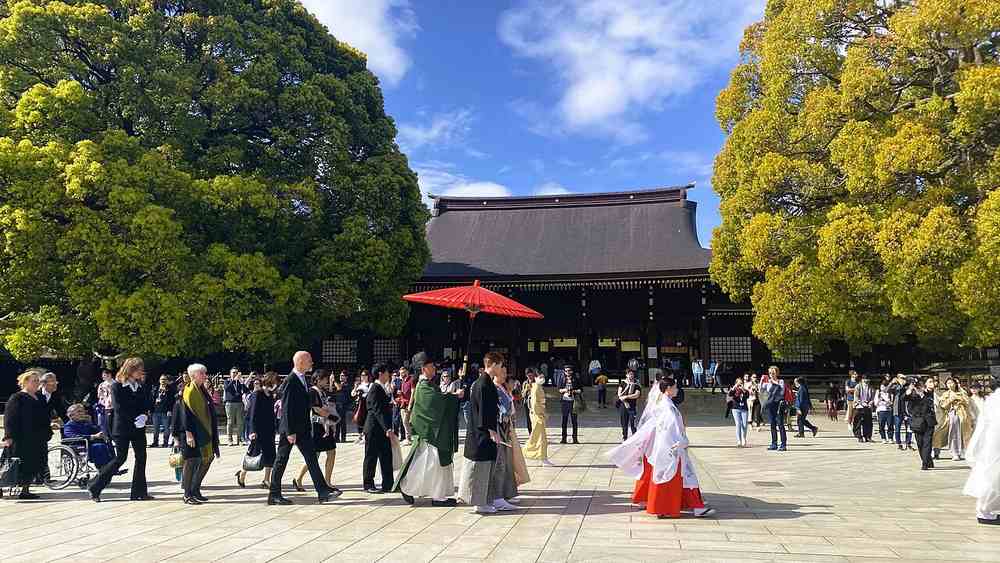 Photo: Wikimedia Commons
Is Meiji Jingū worth visiting?
Yes, if you want quiet rather than spectacle. Meiji Jingū is free, open every day from sunrise to sunset, and sits inside a 70-hectare forest that volunteers planted a century ago on what had been farmland. The walk from the great torii to the main hall takes about ten minutes and is the real experience. Allow 60 to 90 minutes, or two hours with the Inner Garden.
The story
Emperor Meiji died in 1912 and the Diet resolved to build him a shrine. The site chosen at Yoyogi was mostly fields and rough ground, so the foresters Honda Seiroku, Hongō Takanori and Uehara Keiji designed a woodland meant to become self-sustaining within a century. Around 120,000 trees of 365 species arrived as donations from every prefecture, and youth groups from across Japan planted them by hand.
Prime Minister Ōkuma Shigenobu wanted cedar avenues like the ones at Ise and Nikkō. The foresters refused, arguing that cedar would not survive the Kantō loam and the coal smoke of Taishō-era Tokyo, and planted broadleaf evergreens instead. Ōkuma was overruled and the forest lived. The shrine itself did not: air raids destroyed it in 1945, and the buildings standing today were funded by public subscription and finished in October 1958.

Stand under the great torii on the south approach and Kunato tells you the rest — including which prime minister lost the argument over what to plant here.
Hear it in the appVisiting
Gate times change every month with sunrise and sunset — check the official opening-hours page before planning an early or late visit.
Questions travellers ask
Yes. The shrine's own English site states that it is open every day of the year free of charge. Two things inside are ticketed: the Inner Garden, which asks a ¥500 maintenance contribution, and the Meiji Jingū Museum, also ¥500. Everything else — the approach, the great torii, the main hall, the forest paths — costs nothing.
It opens at sunrise and closes at sunset, so the hours change every month. December is shortest at 6:40 to 16:00 and June longest at 5:00 to 18:30. September runs 5:20 to 17:20, March 5:40 to 17:20. Halls and shops inside keep shorter hours, generally 9:00 to 16:00. The official site publishes the full monthly table.
It is a different thing. Kyoto's shrines are genuinely old; Meiji Jingū is a century old and deliberately designed — a forest engineered to look ancient, wrapped around a shrine to the emperor whose reign dismantled the samurai class. Come for the forest and the scale rather than for antiquity. If you are near Harajuku it costs you ninety minutes.

Nearby historic sites in Tokyo
KATARIBE